The key turns—or the start button is pressed—and the vehicle answers with a click, slow cranking, or nothing at all. Before requesting help in West Palm Beach, take one minute to notice what the vehicle is doing and where it is stopped. Those details help roadside assistance arrive prepared for a likely battery problem and identify situations that may require towing instead.
Match the symptom to the information the dispatcher needs
A “dead battery” can describe several different starting failures. Report what you can see and hear without diagnosing the cause yourself.
| What happens when you try to start | What to report | Likely service direction |
|---|---|---|
| Rapid clicking and dim or flickering lights | Say that the starter clicks repeatedly and the lights lose brightness. | A jump-start request may be appropriate. |
| One click, but the engine does not turn | Report the single click and whether the interior lights remain bright. | Battery assistance may be attempted, but towing could be needed if the vehicle still will not crank. |
| No sound and no interior or dashboard lights | State that the vehicle appears to have no electrical power. Mention whether the key fob or power locks work. | A provider can prepare for battery assistance while considering other electrical causes. |
| The engine cranks at normal speed but does not start | Use the exact phrase “it cranks but does not start.” | This is less consistent with a discharged battery; towing may be the practical next step. |
| Power returns after a jump, but the engine stops again | Explain how long it ran and whether warning lights appeared. | Do not assume the vehicle is ready to drive. Towing may be safer. |
| Visible battery damage, smoke, heat, leaking fluid, or strong odor | Describe the condition without touching or leaning over the battery. | Skip the jump attempt and request towing guidance. |
Stop, continue, or change the request?
Use the vehicle’s condition—not simply whether the lights come back on—to decide what happens next.
Continue with a jump-start request
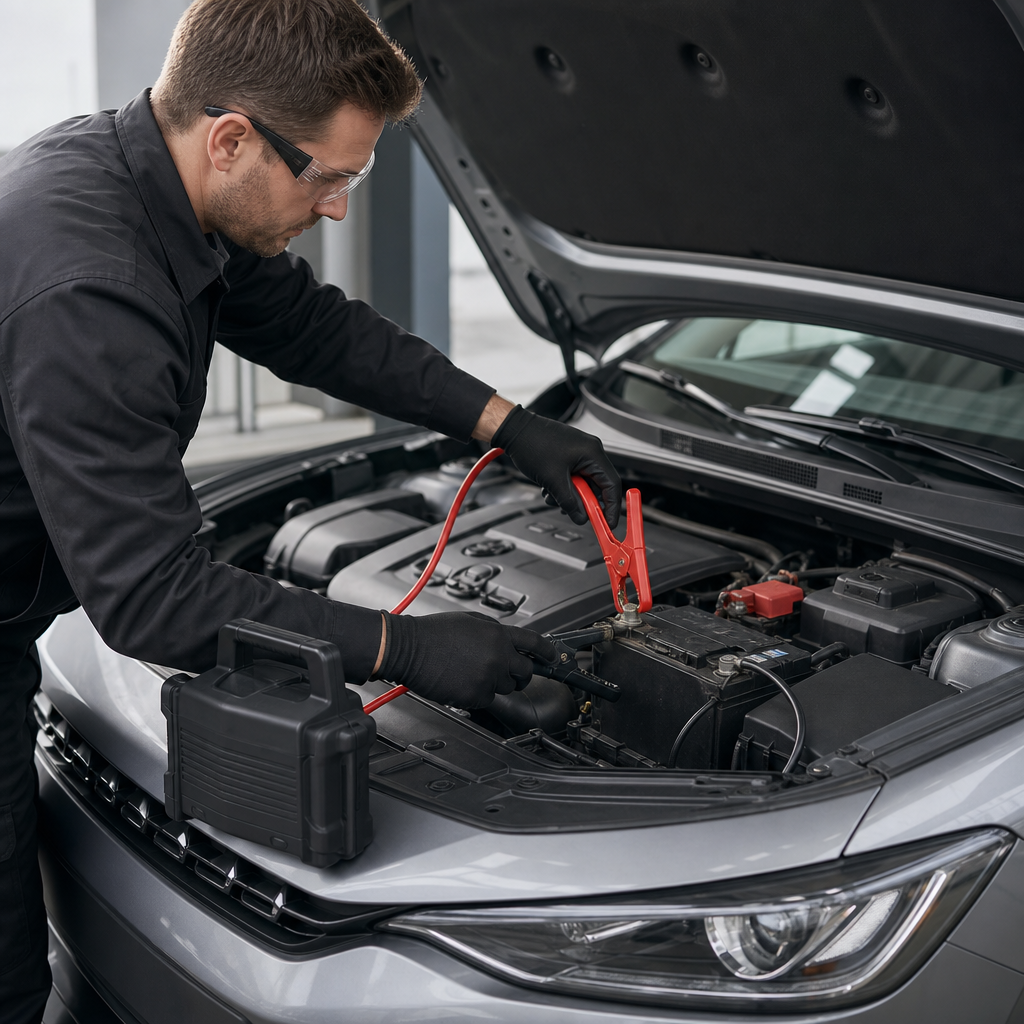
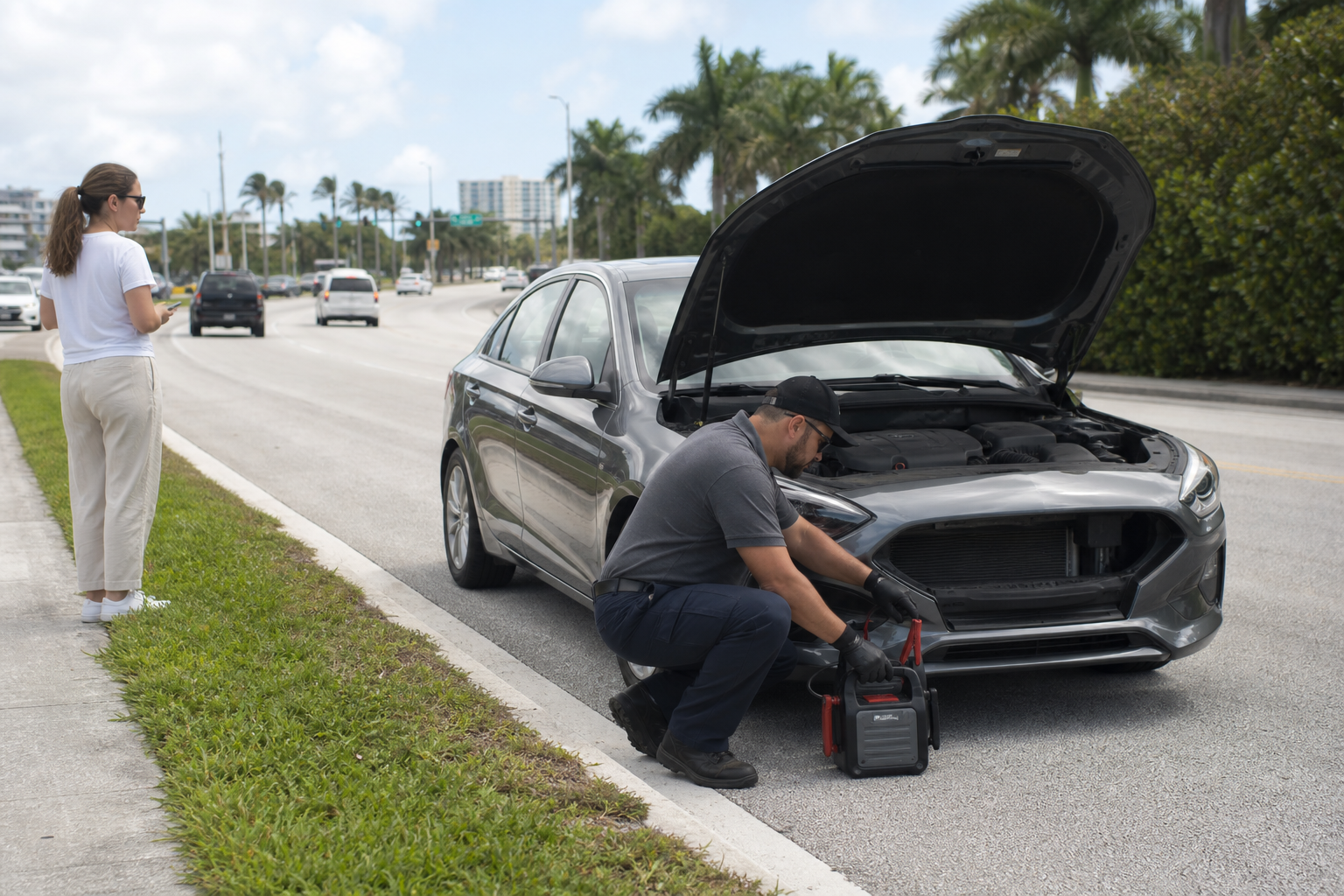
A jump start is a reasonable first request when the vehicle is safely positioned, the battery has no visible damage, and the symptoms are limited to weak electrical power, clicking, or slow cranking. Ask specifically for jump start service rather than reporting only that the car “will not work.”
Stop and request towing guidance
Do not attempt a jump if there is smoke, a burning smell, a strong chemical odor, a swollen or cracked battery case, leaking fluid, damaged cables, or heat around the battery area. Towing is also the clearer request when the engine cranks normally but never starts, the vehicle cannot be accessed safely, or a jump has already failed.
Reassess before driving
A successful start does not automatically mean the vehicle should be driven. Before moving, check that the engine stays running, steering and braking feel normal, and no severe warning or overheating condition appears. If the engine stalls again, electrical power remains unstable, or the vehicle cannot be operated confidently, ask whether flatbed towing is the safer next step.
The roadside checklist: six facts in priority order
Collect these details before placing the request if you can do so safely. The first three help the provider find and approach you; the final three help determine what equipment or service may be appropriate.
- Your precise location: Provide the address, property name if visible, parking level or space, lot entrance, and any gate or access instructions. A dropped map pin can supplement—not replace—a plain-language description.
- The vehicle’s position: Say whether it is in a driveway, parking structure, open lot, roadside area, or another confined space. Report if the front of the vehicle is close to a wall, another car, landscaping, or a locked barrier.
- Immediate safety conditions: Mention passing traffic, poor visibility, standing water, a blocked lane, or any condition that prevents safe access to the vehicle. If the location feels unsafe, say so at the beginning of the call.
- Vehicle identification: Give the year, make, model, color, and plate number if available. Tell the dispatcher if it is a hybrid, electric vehicle, diesel, or has another starting system that may require vehicle-specific procedures.
- The exact starting symptom: Describe clicks, cranking speed, dashboard lights, power locks, and whether the engine ever starts. Avoid replacing observations with “the battery is definitely dead.”
- What has already been tried: Report previous jump attempts, how the vehicle responded, and whether it started and stalled. Do not keep making repeated attempts while waiting.
Prepare the vehicle without creating a new hazard
Remain with the vehicle only if the location is safe. Keep the keys and phone with you, unlock the vehicle if appropriate, and make sure the hood release is accessible. Move loose belongings only when they block access to the battery area; there is no need to remove battery covers or connect cables yourself.
If the battery is not under the hood, do not dismantle interior or cargo-area panels. Tell the provider what the owner’s manual indicates about the battery or designated jump points. For hybrids and electric vehicles, identify the vehicle accurately and wait for vehicle-appropriate guidance rather than touching high-voltage components.
A dispatcher-ready request
Use this compact format so the essential facts are not buried:
“I need battery assistance in West Palm Beach, Palm Beach County. I am at [exact location and access instructions]. The vehicle is a [year, make, model, color]. It is [safely parked or exposed to a specific hazard]. When I try to start it, [exact sound and dashboard behavior]. [No jump has been attempted / a jump was attempted with this result]. The battery has [no visible damage / this visible concern].”
If the battery appears undamaged and the vehicle only clicks or cranks slowly, request a jump start. If there is battery damage, an unsafe working area, normal cranking without ignition, or a failed jump attempt, ask for a towing decision instead. That distinction helps avoid sending the wrong service for the vehicle’s current condition.
Frequently asked questions
Should I tell roadside assistance that I already tried a jump?
Yes. State what equipment was used, whether the engine cranked or started, and whether it stalled afterward. A failed attempt can change the recommended service.
Why does the vehicle’s parking position matter?
The provider needs enough safe working access near the designated jump points. A vehicle facing a wall, parked in a tight structure, or blocked by other vehicles may require different equipment or a towing plan.
Can I request a jump if the engine cranks but will not start?
You can request assistance, but clearly report that it “cranks normally but does not start.” That symptom is not the typical pattern of a discharged battery and may lead to a towing recommendation.
After a successful jump, should I drive immediately?
Not until the vehicle remains running and appears safe to operate. If it stalls, shows unstable electrical power, overheats, or presents serious warnings, stop and request towing guidance.
What if I cannot identify the battery location?
Do not take panels apart. Provide the vehicle’s year, make, model, and powertrain type, and let the roadside provider locate the approved connection points.