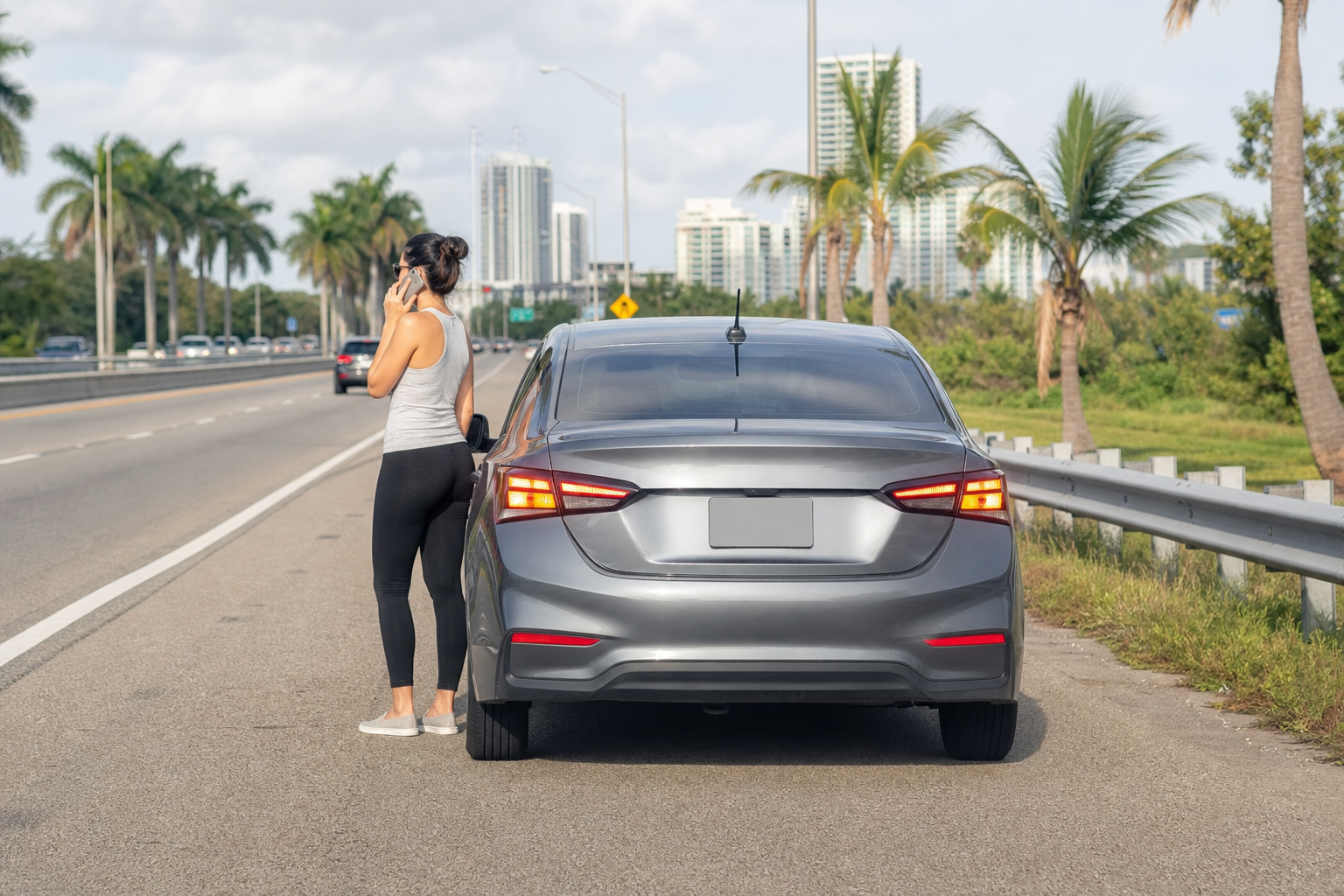
A vehicle problem can feel much more urgent when traffic is moving quickly around you. On roads such as I-95, Okeechobee Boulevard, Southern Boulevard, Palm Beach Lakes Boulevard, and US-1, the first priority is not diagnosing the problem. It is getting yourself and your passengers out of immediate danger.
Whether your car will not restart, has a flat tire, overheats, loses power, or displays a warning light that makes continued driving feel unsafe, use a simple approach: create space from traffic, make your vehicle visible, share a precise location, and wait in the safest practical place for help.
Do This First: A 60-Second Breakdown Response
- Turn on your hazard lights immediately.
- If the vehicle still moves safely, steer toward the right shoulder, a parking lot, side street, or other area away from moving lanes.
- Do not stop in a travel lane unless the vehicle cannot be moved.
- Put the vehicle in park, set the parking brake, and keep your wheels turned away from traffic when parked along a curb or shoulder.
- Check your surroundings before opening any door or stepping outside.
- Call for roadside assistance or towing and give the dispatcher your direction of travel, nearest cross street, landmark, and vehicle details.
Decide Whether You Can Move the Vehicle
If your vehicle remains controllable and moving it will not create additional risk, getting out of the traffic stream is usually the best next step. A nearby gas station, shopping center entrance, parking lot, or quiet side street may be safer than waiting beside fast-moving vehicles.
Do not continue driving just to reach a preferred destination if the car is overheating, has a severely damaged tire, is producing smoke, has steering or braking trouble, or is losing power unpredictably. In those situations, pull over as soon as it can be done safely and arrange help.
On I-95 or another high-speed roadway
Use your hazards, reduce speed gradually, and move as far right as conditions allow. Avoid sudden braking, sharp steering, or trying to cross multiple lanes at once. If you reach a shoulder, stop as far from the travel lane as practical. If there is no safe shoulder or the vehicle is blocking traffic, focus on making your location clear when calling for assistance.
On busy city corridors
On roads such as Okeechobee Boulevard or Southern Boulevard, intersections, turn lanes, driveways, and commercial entrances can create unpredictable traffic movement. If the car can roll safely, a nearby lot may offer more protection than remaining at the edge of a multilane road. Be careful not to block an entrance, fire lane, or active driveway.
Make Your Vehicle Easier for Other Drivers to See
Hazard lights are your first visibility tool. Keep them on while your vehicle is stopped, including during daylight. If it is dark, raining, or visibility is poor, turn on interior lights only if they help you gather belongings; exterior hazard lights remain the main signal to approaching drivers.
If you have warning triangles or other roadside visibility equipment, use them only when it is safe to leave the vehicle and place them. Do not walk into active lanes to set up equipment. Your personal safety matters more than creating a longer warning zone.
At night or during Florida rain, passing drivers may have less time to recognize a stopped car. Stay alert for traffic movement and avoid standing directly behind, in front of, or beside the vehicle where another driver could drift toward you.
Where Should You Wait?
The safest waiting spot depends on where the vehicle stopped and how close traffic is.
- If you are safely in a parking lot or on a quiet street: You may usually wait inside the locked vehicle, provided the location feels secure and there is no sign of smoke, fire, or another immediate hazard.
- If you are on a shoulder next to fast traffic: Consider whether there is a protected area well away from traffic that can be reached without crossing lanes. Do not stand between your vehicle and moving traffic.
- If the vehicle is in a travel lane: Keep occupants focused on safety, communicate the situation clearly when requesting help, and follow directions from emergency responders if they arrive.
- If there is smoke, a burning smell, or visible fluid danger: Move away from the vehicle to a safer location if you can do so without entering traffic.
If children, older adults, pets, or passengers with mobility needs are with you, tell the towing dispatcher. This helps the provider understand that the roadside situation may require extra care and clear coordination.
What to Tell a West Palm Beach Towing Provider
Accurate location details can make a major difference, especially near large intersections, highway ramps, and divided roads. Before calling, look for road signs, business names, mile markers, exit information, or nearby cross streets.
Have these details ready
- Your exact road and direction of travel, such as eastbound or northbound.
- The nearest cross street, exit, ramp, landmark, or recognizable business.
- Where the vehicle is positioned: shoulder, parking lot, driveway, median area, travel lane, or side street.
- Your vehicle's make, model, color, and license plate information if requested.
- The issue you noticed, such as a no-start condition, flat tire, overheating, dead battery, or loss of power.
- Whether the vehicle needs a tow or may only need roadside help.
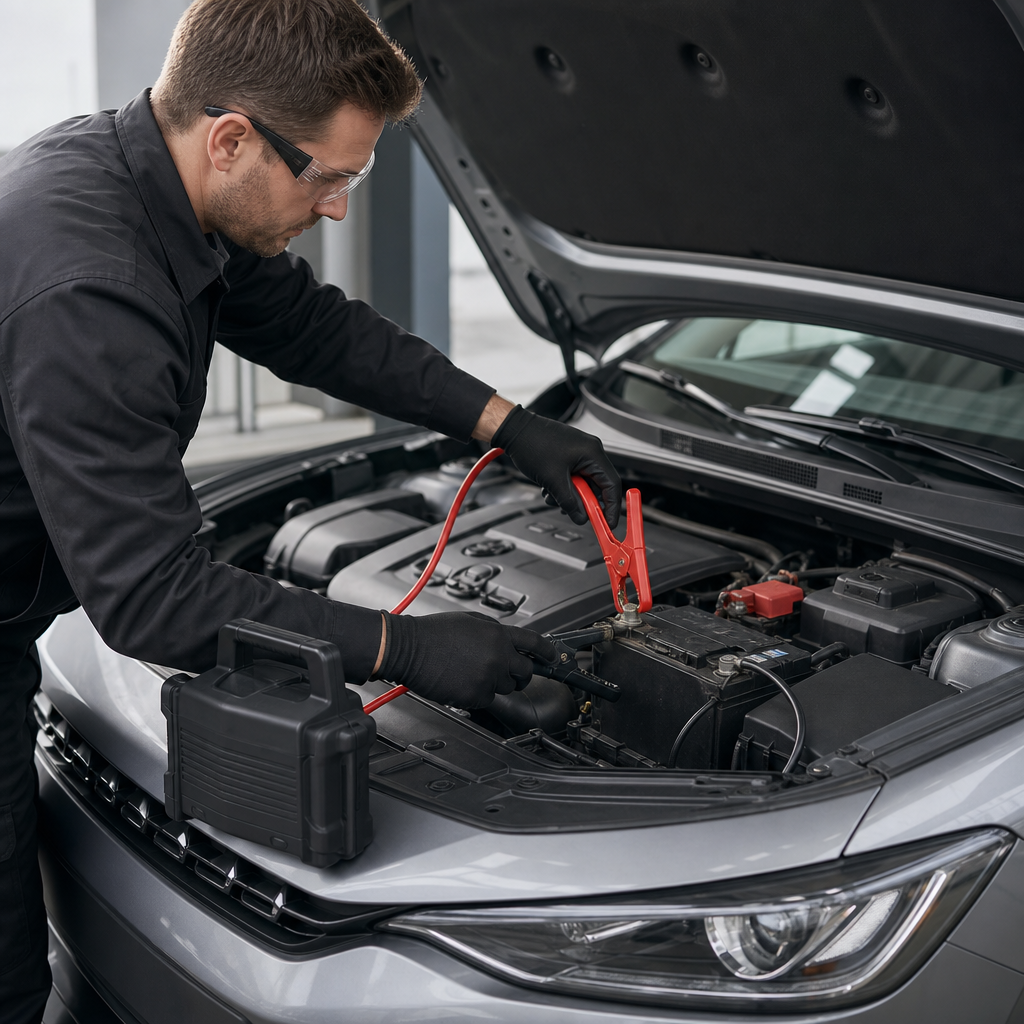
For a vehicle that will not start but is already parked safely, a jump start service may be appropriate. If the car cannot be driven safely, has wheel or tire damage, or needs to be transported without rolling under its own power, request flatbed towing or explain the condition so the dispatcher can recommend the right equipment.
When to Call for Help Instead of Trying a Quick Fix
It is reasonable to handle a simple issue yourself only when you are in a safe location, have the necessary equipment, understand the task, and can work without exposure to moving traffic. On a crowded road, the safer choice is often to call for help rather than attempt a repair on the shoulder.
Request emergency towing or roadside assistance when:
- Your vehicle is stopped in an unsafe position or cannot be moved away from traffic.
- You have a flat tire but the roadside location is too exposed to change it safely.
- The engine will not restart and you are unsure whether the battery is the cause.
- The vehicle is overheating, smoking, leaking noticeably, or showing signs that continued driving could be unsafe.
- You have steering, braking, transmission, or power-loss symptoms.
- You are stranded after dark, during heavy rain, or in an unfamiliar area.
- You need the vehicle transported to another location.
A 24-hour towing service is especially useful when a breakdown happens outside normal business hours or when you need help coordinating a safe tow from a busy roadway.
Practical Checklist While You Wait
- Keep your phone charged if possible and silence nonessential notifications.
- Share your location with a trusted contact if you are alone.
- Keep hazards on and remain aware of traffic around the vehicle.
- Gather your driver's license, registration, insurance information, keys, and destination details if a tow is needed.
- Remove only essential personal belongings if the vehicle will be transported.
- Take a few photos of the vehicle's condition if it is safe to do so from a protected location.
- Confirm the tow destination before the truck arrives.
- Do not accept help from an unfamiliar person if you feel uncomfortable; wait for the provider you contacted.
After the Tow Truck Arrives
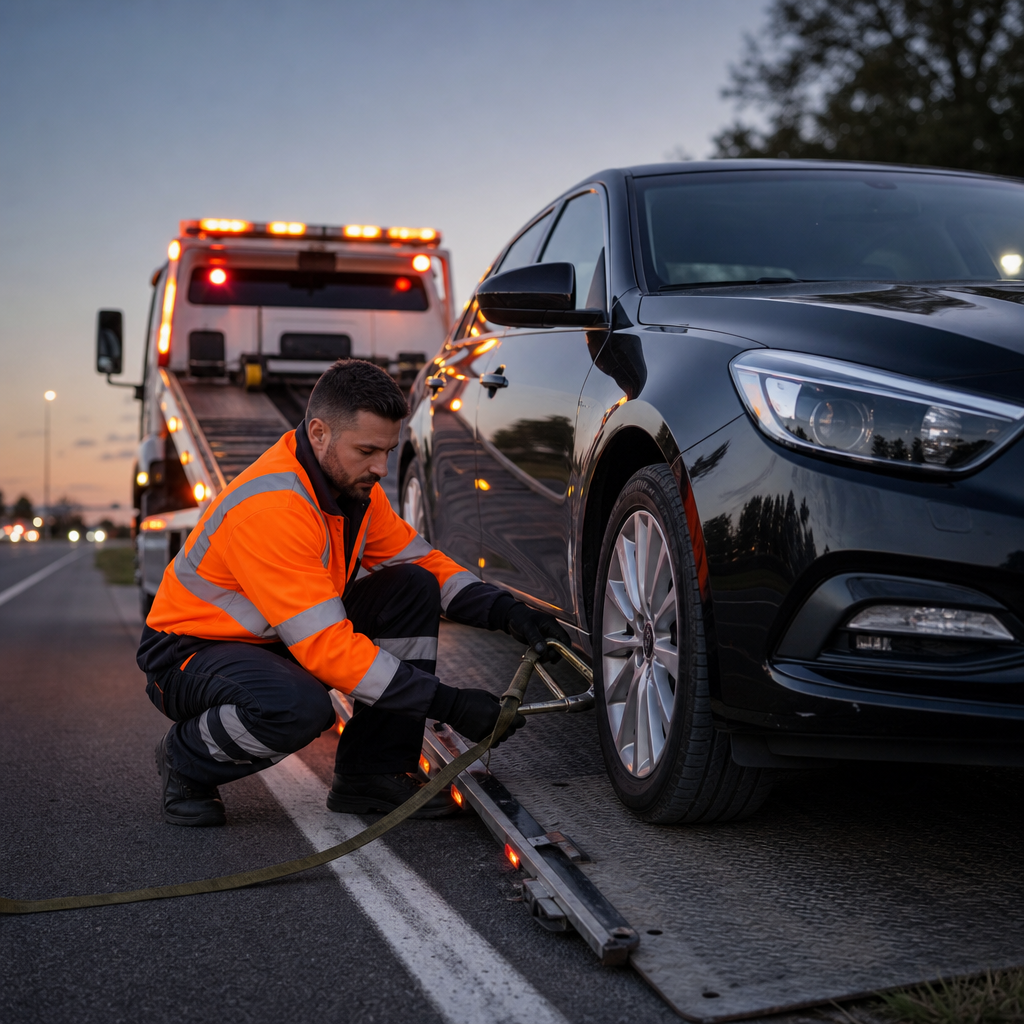
Before loading begins, confirm that the arriving provider has your correct vehicle and destination information. Point out any relevant concern, such as a low-clearance area, a locked wheel, a flat tire, or a vehicle that cannot be started. Follow the operator's instructions about where to stand while the vehicle is being prepared for transport.
Keep passengers away from the loading area. A busy roadside is not the place to inspect every mechanical detail; the immediate goal is to get the vehicle secured and clear of traffic safely.
Frequently Asked Questions
Should I stay in my car during a breakdown on a busy West Palm Beach road?
If you are safely off the roadway in a parking area or protected location, staying in the locked vehicle may be appropriate. If traffic is passing very close to the vehicle, assess whether there is a safer protected place nearby that you can reach without crossing lanes. Conditions vary, so prioritize distance from moving traffic.
What location details are most useful when requesting a tow?
Give the road name, direction of travel, nearest cross street or exit, and your exact position, such as a shoulder, parking lot, ramp, or travel lane. Nearby landmarks can also help when street signs are limited.
Can I request a tow if my car is parked at home or at work?
Yes. Towing is not limited to highway breakdowns. If your vehicle will not start or cannot be driven safely from a home, workplace, parking lot, or other private location, explain the access conditions and desired destination when you call.
Should I try a jump start before arranging a tow?
If the vehicle is already parked safely and the symptoms suggest a weak battery, roadside jump-start help may be worth requesting. If the vehicle is in an exposed roadside position, has other warning signs, or does not start after assistance, towing may be the safer next step.
What should I remove from my car before it is towed?
Take essential valuables, medications, identification, keys, and items you will need at your destination. Avoid spending extra time unloading the vehicle if you are stopped near active traffic.