
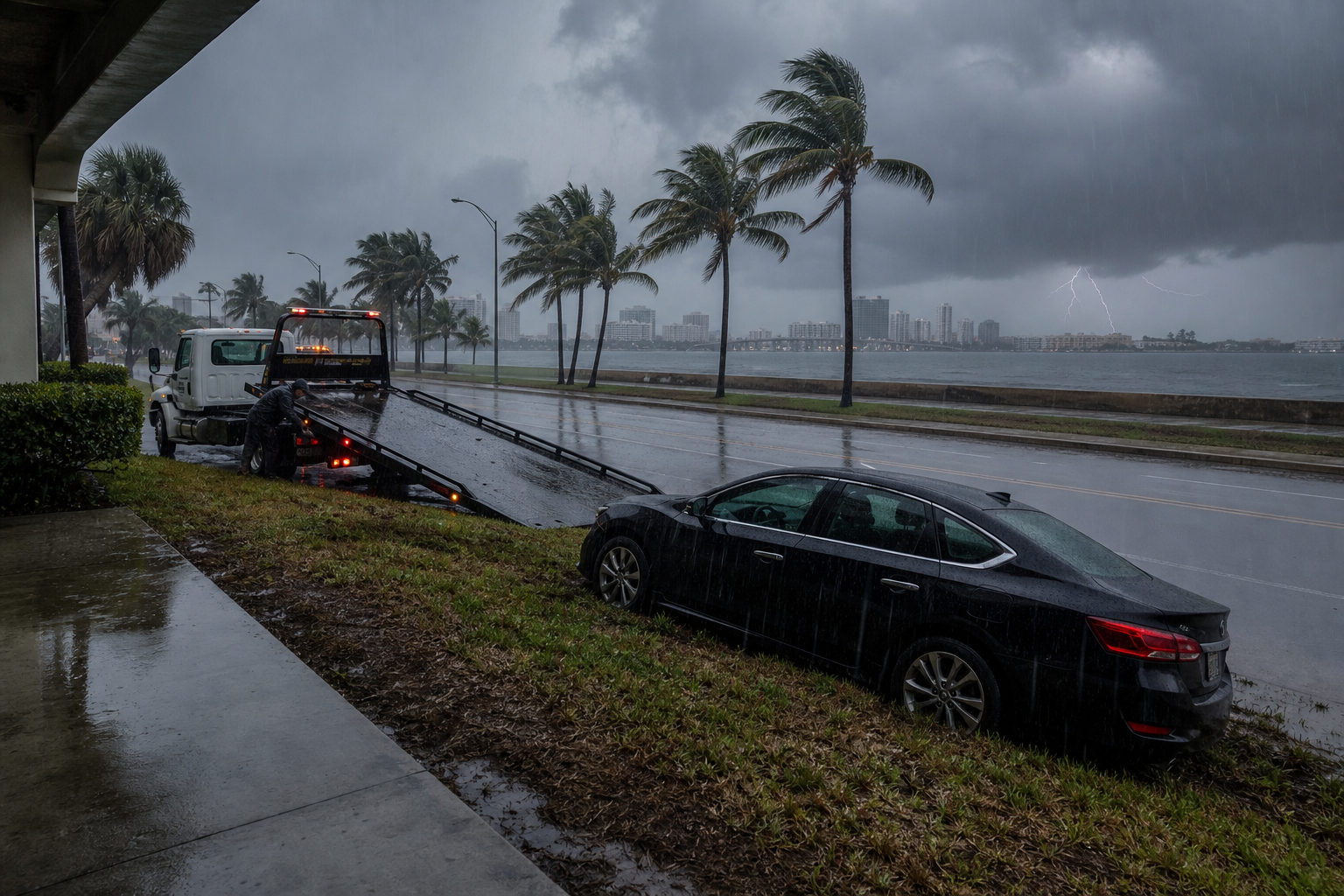
Use this decision rule immediately: if your fully enclosed, hard-topped vehicle is out of moving traffic and has no smoke, fire, rising water, or impact risk, stay inside it during lightning. If the vehicle itself is unsafe, move to a substantial enclosed building without crossing traffic or entering floodwater.
Do this now
- Get as far out of moving traffic as the vehicle can safely travel.
- Stop, set the parking brake, turn on hazard lights, close the windows, and switch off the engine.
- Stay in the enclosed vehicle unless fire, smoke, water, or traffic exposure makes it more dangerous than leaving.
- Call for roadside help and give your exact location, travel direction, vehicle description, and visible symptoms.
Lightning and heavy rain create two separate hazards for a stranded driver: exposure to the storm and reduced visibility for approaching traffic. The safest waiting place depends first on where the vehicle stopped and then on its condition. This West Palm Beach handbook follows that decision from the first warning signs through the service handoff.
Before the problem: recognize when driving should stop
Do not wait for a complete breakdown if the vehicle is already giving you a safe chance to leave moving traffic. Heavy rain can hide lane edges, debris, standing water, and stopped vehicles. Lightning may also arrive while you are deciding what to do.
Ease off the accelerator, avoid abrupt steering, and look for a place where the entire vehicle can be separated from traffic. Do not drive into water when you cannot see the roadway beneath it. A shoulder or parking area is useful only if you can reach it without making a sudden maneuver or crossing unknown water.
Pull over and request help if:
- Visibility is too poor to identify the path ahead consistently.
- The engine is losing power, stalling, overheating, or producing smoke.
- A tire, wheel, steering, or suspension problem affects control.
- Water has entered the cabin or critical warning lights appeared after contact with standing water.
- The windshield wipers, exterior lights, or defogging system cannot provide usable visibility.
A weak or dead battery after the storm may be suitable for jump-start service, but only when the vehicle is in a safe working area and no other damage is evident. A jump is not a test of whether a water-exposed or mechanically damaged vehicle is safe to drive.
At the roadside: choose the least dangerous waiting place
Once stopped, compare the risks inside and outside the vehicle. During lightning, a fully enclosed hard-topped vehicle usually provides a better waiting space than standing outdoors. Its metal body—not its tires—helps direct electrical current around the passenger compartment. Close the windows and avoid leaning against metal trim, doors, or connected electrical equipment.
Keep your seat belt fastened if there is any possibility that another vehicle could strike yours. Put the transmission in park, set the parking brake, and leave the hazard lights on. At night or in poor visibility, interior lights can make it harder to see outside, so use them only as needed.
Stay inside when all of these are true
- The vehicle is fully enclosed and hard-topped.
- It is outside the active path of traffic.
- There is no smoke, fire, fuel odor, or rapidly worsening mechanical condition.
- Water is not entering or rising around the vehicle.
- The vehicle is not beneath a falling object or exposed to an obvious collision risk.
Leave only when the vehicle is the greater danger
Exit for smoke, fire, rising water, or an immediate threat from traffic or unstable surroundings. If you must leave, move away from traffic and toward a substantial enclosed building if one is safely reachable. Do not wait beneath an isolated tree, beside a metal fence, in an open shelter, or in an exposed field. Avoid standing in pooled water.
If anyone is injured, the vehicle is on fire, or the location presents an immediate threat to life, contact emergency services first. Towing dispatch is the next call after urgent safety needs are addressed.
While waiting: make yourself locatable without stepping into danger
A towing provider needs precise information more than a roadside signal placed outside the car. Do not walk along the road to look for an address, set out equipment during active lightning, or stand beside the vehicle to wave down the driver.
Roadside waiting checklist
- Share your phone’s map location or a nearby verified address.
- State that you are in West Palm Beach, Palm Beach County, Florida.
- Describe which direction the vehicle was traveling and where it is positioned.
- Give the vehicle color, body style, and plate information if requested.
- Report heavy rain, low visibility, standing water, lightning, or limited access.
- Describe warning lights, noises, leaks, smoke, water entry, and loss of steering or braking.
- Tell dispatch whether everyone is staying inside or has moved to a building.
- Keep the phone available for location questions, but conserve its battery.
- Do not attempt a roadside inspection while lightning is active.
For a vehicle that cannot move safely, contact emergency towing assistance. If conditions or vehicle damage require transport rather than an on-site attempt, flatbed towing can keep all four wheels off the road. Drivers needing assistance outside normal business hours can request 24-hour towing in West Palm Beach.
After service arrives: decide between a tow and driving away
Stay in your protected waiting place until the operator identifies themselves and gives clear instructions. The operator may need room to position the truck or may ask you to remain inside while traffic and storm conditions are evaluated. Do not stand between the vehicles or beside towing equipment.
Give a short sequence of what happened: the weather conditions, the first symptom, any warning lights, whether the engine stalled, and whether the vehicle contacted standing water. Mention any failed steering, braking, tire, wheel, or visibility equipment. This information helps determine whether roadside assistance is appropriate or whether loading the vehicle is the safer choice.
Driving may be reasonable only when:
- The original problem has been clearly addressed.
- No steering, braking, tire, wheel, electrical, or visibility issue remains.
- There is no smoke, leaking fluid, unusual noise, water intrusion, or persistent warning light.
- The operator can finish the service in a safe location.
- Road visibility is adequate for controlled travel.
Choose a tow when:
- The cause of a stall or power loss is uncertain.
- The vehicle contacted standing water and now runs poorly or shows warnings.
- Steering, braking, tires, wheels, or suspension may be compromised.
- Wipers, lights, or defogging cannot maintain visibility.
- The vehicle cannot be safely evaluated where it stopped.
- You would need to drive through the same unsafe water or visibility conditions to leave.
Do not let a successful restart become the only reason to drive. A running engine does not confirm that the vehicle can steer, stop, remain visible, or continue operating without damage.
Questions drivers ask while the storm is active
Is it safer to wait inside my car during lightning?
Usually, yes—if it is a fully enclosed, hard-topped vehicle positioned outside moving traffic and there is no fire, smoke, rising water, or collision threat. Close the windows and avoid contact with metal surfaces and connected electrical equipment.
Should I stand under a tree while waiting for the tow truck?
No. An isolated tree does not provide safe lightning shelter. Remain in a safe enclosed vehicle or move to a substantial enclosed building when it can be reached without entering traffic, floodwater, or another exposed area.
Can a tow truck work while lightning is nearby?
The operator must assess conditions at the scene. Hookup and loading may pause if lightning, water, visibility, or traffic makes outside work unsafe. Stay where directed rather than approaching the equipment.
My vehicle restarted after heavy rain. Do I still need a tow?
A restart alone is not enough to make the drive decision. Request a tow if warning lights remain, water entered the vehicle, the engine runs differently, or steering, braking, tires, lights, wipers, or defogging are not fully functional.
What should I tell towing dispatch first?
Start with your exact location, travel direction, vehicle description, and whether the car is fully outside moving traffic. Then report lightning, heavy rain, standing water, injuries, smoke, water entry, or mechanical symptoms so the service can be planned around the actual roadside conditions.
Calm handoff: once everyone is in the safest available place, contact a West Palm Beach towing provider, describe the scene plainly, and follow the operator’s instructions. The immediate goal is not to diagnose the vehicle in the rain; it is to keep people protected and move the vehicle only when conditions allow.