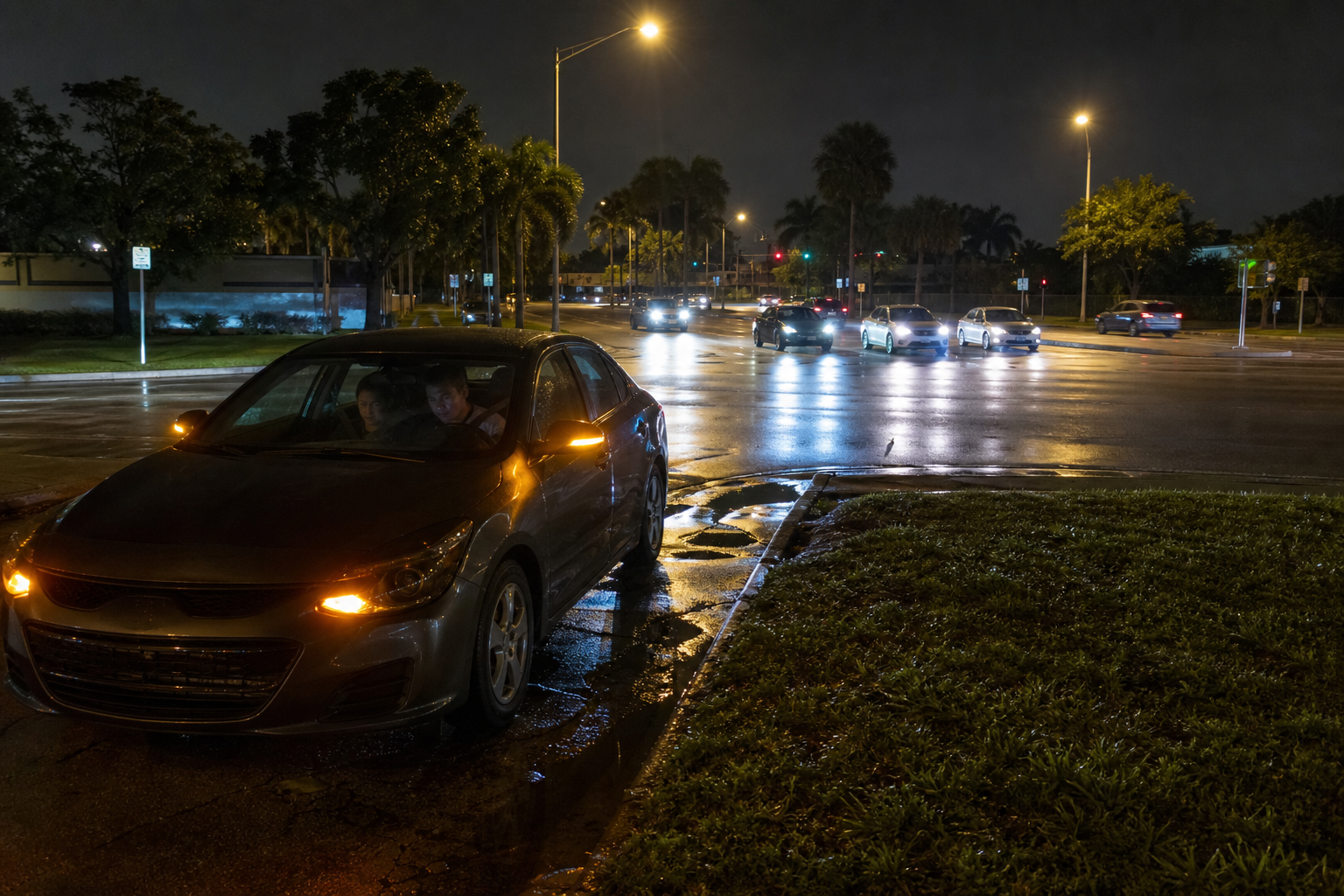
If your car remains in or obstructs a West Palm Beach intersection, turn on the hazard lights, keep your foot firmly on the brake, stay belted, and call 911 promptly. A vehicle blocking live lanes is an immediate traffic hazard. Do not wait several minutes to see if it resolves, and do not step into moving traffic to inspect or push the car. Move only if the vehicle can travel under its own power and a clearly open route leads directly out of the intersection.
First 10 minutes: from traffic hazard to a safe service request
Minute 0–1: stabilize and make yourself visible
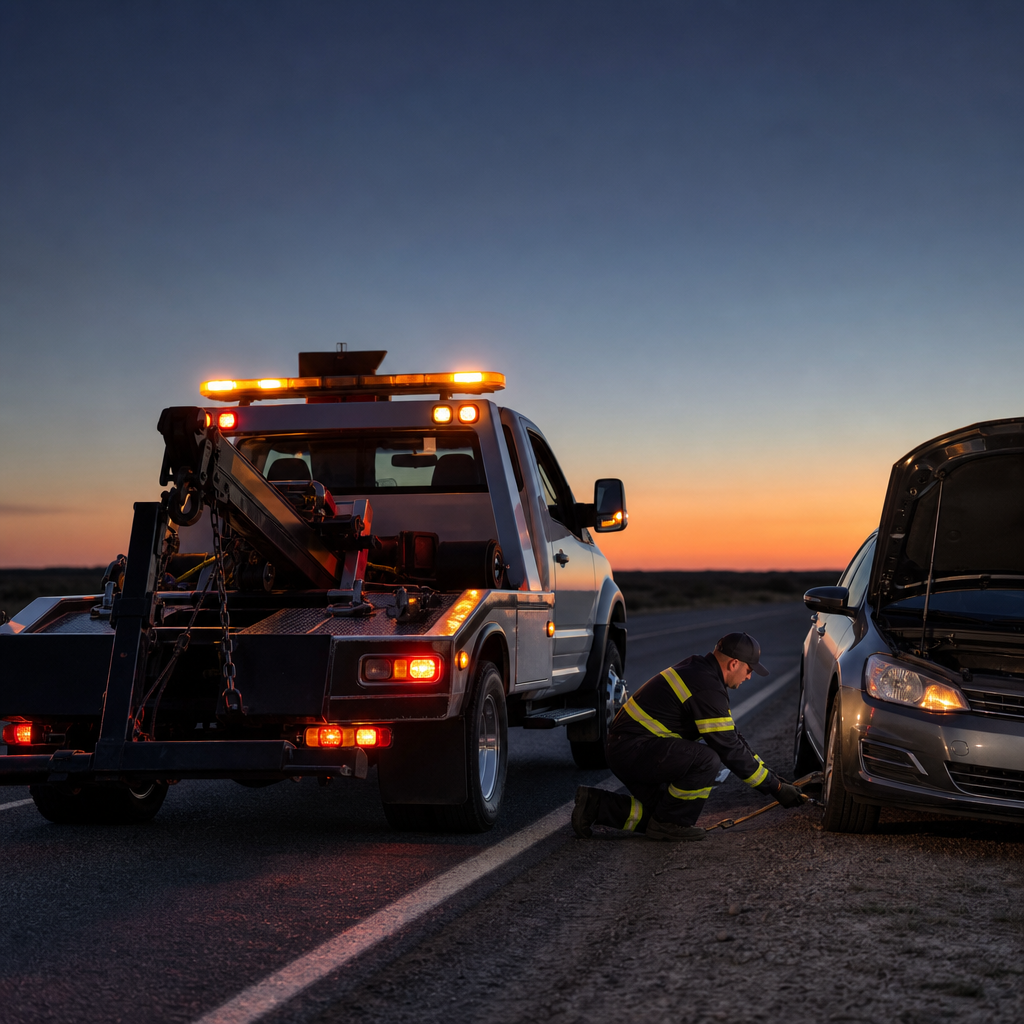
Switch on the hazard lights, keep the vehicle in place with the brake, and take a quick look at surrounding traffic without opening a door. After dark, other drivers may have difficulty judging that your car is stationary, especially amid headlight glare or reflections on wet pavement.
If any part of the vehicle is still within the intersection or a live lane, call 911 promptly. State that the car is disabled and obstructing traffic. Towing or roadside assistance can remove the vehicle, but it does not replace emergency traffic-hazard reporting.
Minute 1–3: move only when the route is unquestionably clear
If the engine restarts and the car responds normally enough to move, proceed only when there is a direct, clearly safe route out of the intersection. Do not improvise a turn through cross traffic or force the car across multiple lanes. If the route is uncertain, remain stopped with the hazards on and follow the 911 operator’s instructions.
Do not ask passengers or bystanders to push the car through an active intersection. That places people outside the vehicle where approaching drivers may not see them.
Minute 3–5: choose the safer place for occupants
Remaining belted inside is generally safer than standing beside a disabled car in traffic. Exit only when all three conditions are present: the vehicle is at immediate risk, a protected area is immediately reachable, and everyone can reach it without entering or crossing a live lane. Otherwise, keep doors locked, limit window opening, and wait for directed help.
If the vehicle is fully outside traffic, assess the surroundings before getting out. At night in West Palm Beach, choose visibility and personal security over inspecting the car. Avoid waiting in a dark or isolated spot away from your vehicle unless emergency personnel direct you there.
Minute 5–10: arrange the correct roadside response
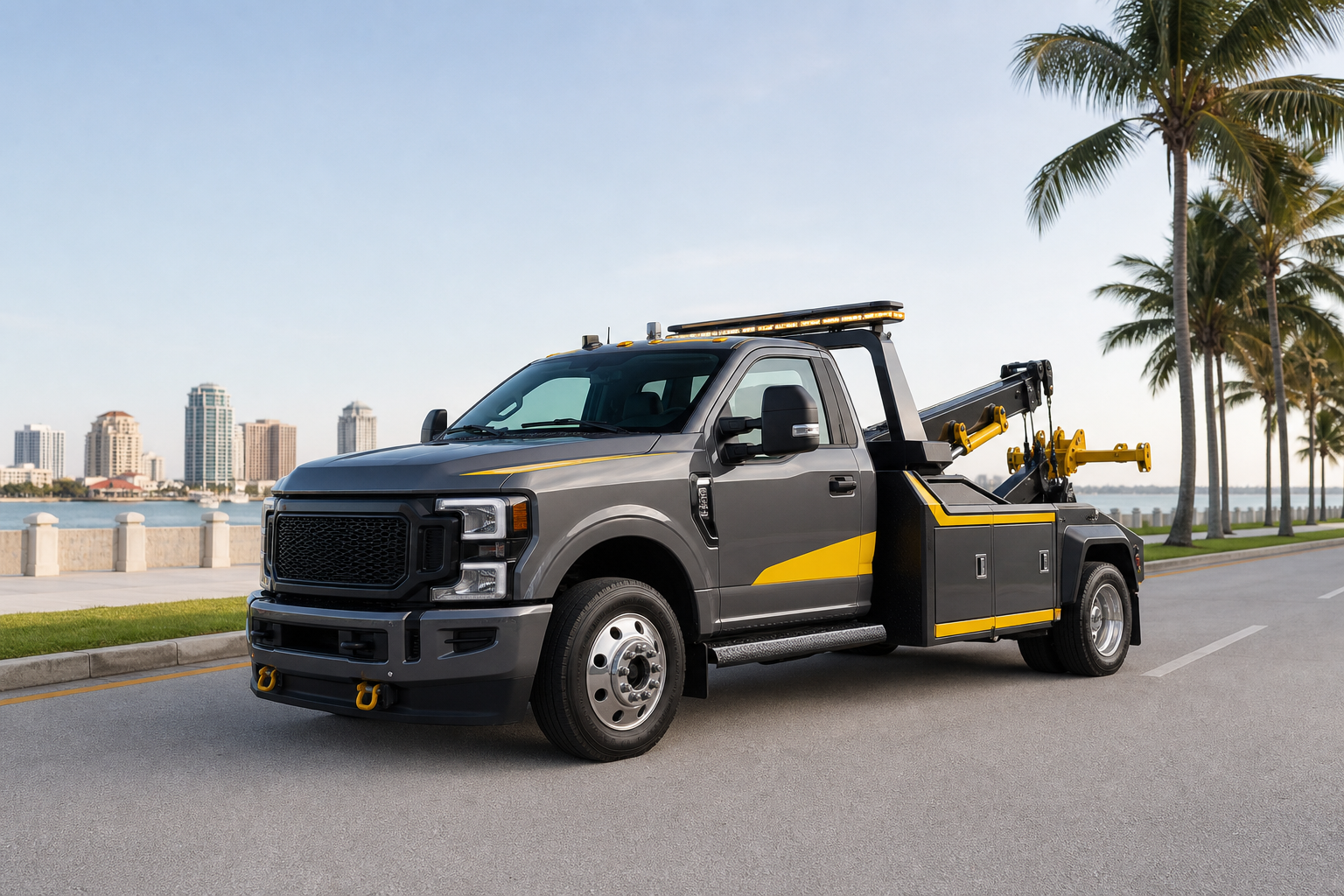
Once the immediate traffic hazard has been reported—or if the car is already safely outside all lanes—request emergency towing in West Palm Beach. Tell the provider whether the vehicle starts, rolls, steers, and can be reached without entering the intersection.
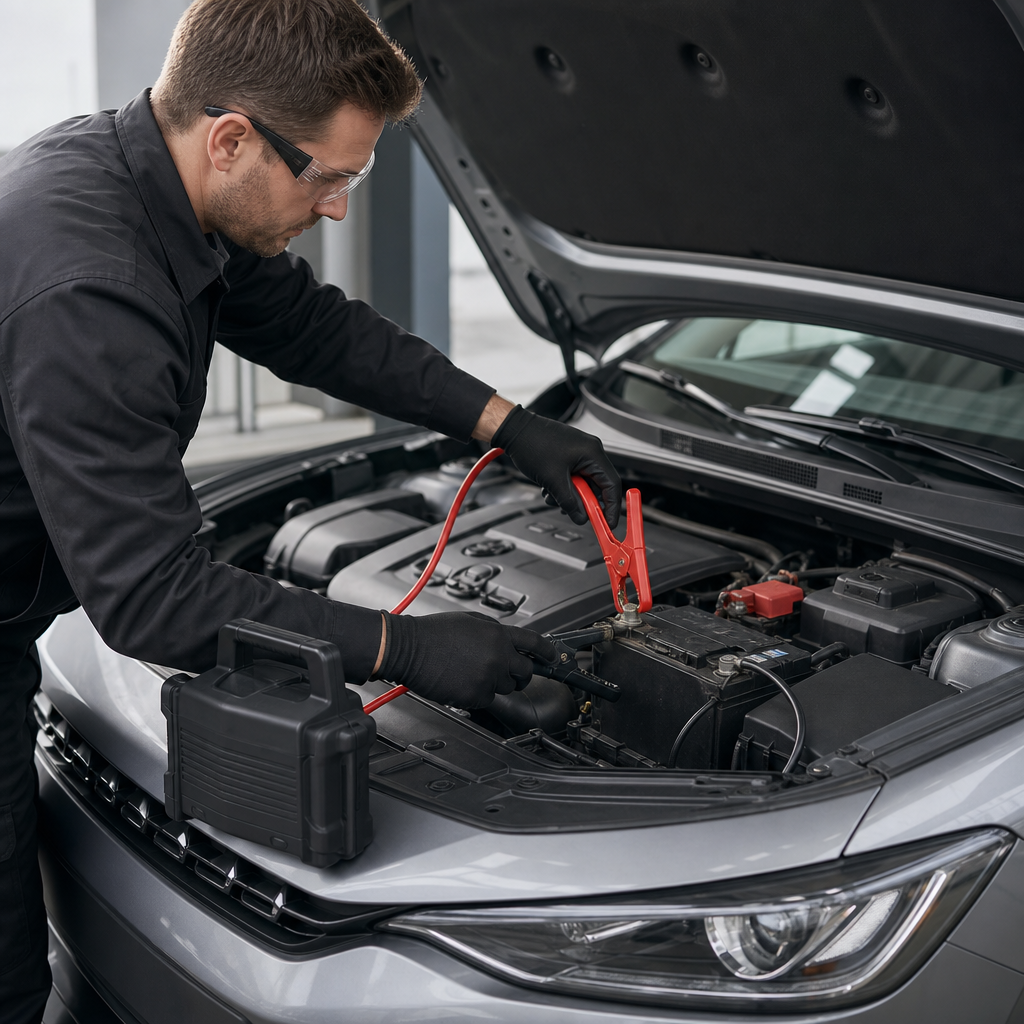
A jump start should be considered only when the vehicle is in a protected location where roadside work can be performed away from moving traffic. If that condition is met and the symptoms fit a discharged battery, request jump start service. Do not attempt a roadside jump while the car remains exposed in the intersection.
Decision points: stay, move, call, or tow
- Is the car still obstructing the intersection?
- Call 911 promptly. Keep hazards on, remain belted, and do not leave the vehicle unless an immediately available protected route is clearly safer.
- Can the car move under its own power?
- Move only along a clearly open path to a position completely outside travel lanes. Stop attempting to move if steering, braking, or forward motion is unreliable.
- Is the car already fully off the roadway?
- Arrange towing or roadside assistance. Remain in a visible, secure location and tell the provider how the vehicle can be accessed.
- Does the car only click or show weak electrical power?
- A jump may be appropriate, but only from a protected service position. Exposure to traffic takes priority over diagnosing the starting problem.
- Can the vehicle not roll, steer, or be moved normally?
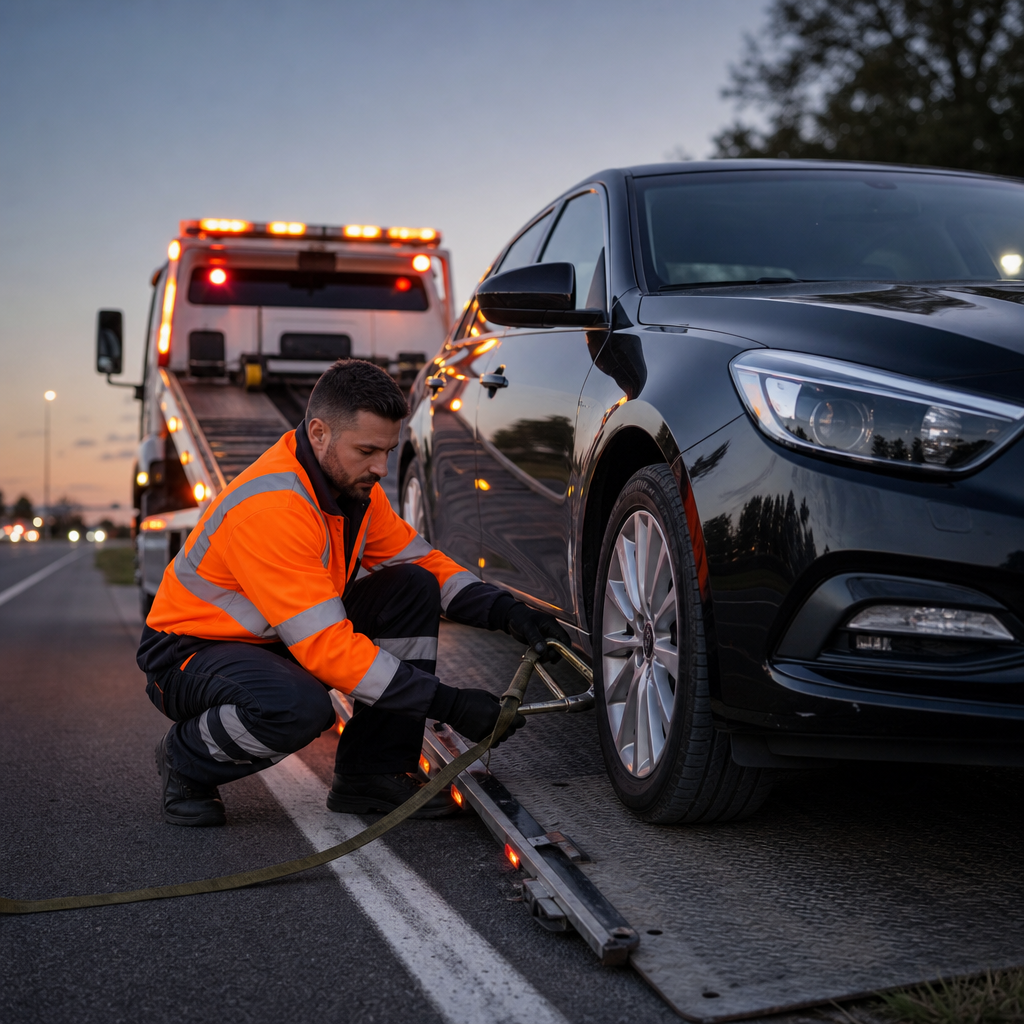
- Report that limitation when requesting flatbed towing. The towing provider can determine the suitable loading method from the vehicle’s condition and position.
What to report so help can find and handle the car
Give concise, observable facts rather than a long explanation. In West Palm Beach, an intersection may have several approaches and turn lanes, so the vehicle’s exact position is more useful than saying only that you are “at the light.”
- Your location in West Palm Beach, Palm Beach County, Florida
- The names shown for both intersecting streets, if safely readable
- Your direction of travel and lane position
- Whether any portion of the car blocks the intersection or a live lane
- Vehicle color, body style, and other easy identifiers
- Whether the hazard lights are working
- Whether the engine starts and whether the car can roll, steer, and brake
- How many occupants are inside and whether anyone needs medical help
- Any immediate visibility or personal-safety concern
Do not walk into traffic to read a street sign or inspect damage. Use information visible from the cabin, a phone map, or a safely reached protected area.
What towing or roadside help does next
The service provider first uses your location, lane status, and vehicle condition to decide what equipment may be needed. Keep your phone available in case the operator needs a more precise description of the vehicle or its access point.
If the car is still in the intersection, emergency responders may address the active traffic hazard before a tow operator can approach. Follow their directions and update the towing provider if the car is moved to another position.
Once the scene can be approached safely, the operator will assess how the car can be loaded or assisted. A jump start may be attempted only from a safe working position. If the vehicle cannot be safely started or moved, towing becomes the next step. A flatbed may be selected when keeping the vehicle’s wheels off the roadway is the appropriate loading method.
Before help arrives
- Keep hazards operating if electrical power allows.
- Stay belted unless a protected exit is clearly safer.
- Keep doors locked if you feel exposed or uneasy.
- Do not stand between vehicles or beside a traffic-facing door.
- Keep your phone charged and answer calls from the provider.
- Update 911 or the towing provider if the vehicle’s position changes.
- Have the key accessible without leaving the cabin to retrieve belongings.
West Palm Beach intersection-stall FAQs
Should I call 911 or a towing company first?
If the vehicle remains in or obstructs the intersection, call 911 promptly because it is an active traffic hazard. After reporting the hazard, arrange 24-hour towing when it is safe to do so. If the car is already completely outside traffic and nobody is in immediate danger, contact roadside assistance or towing directly.
Should I get out and push the car?
No. Do not push a vehicle through an active intersection or ask passengers and bystanders to do so. People outside the car are harder for approaching drivers to see, particularly at night.
Is it safer to wait inside after dark?
Usually, staying belted inside is safer than standing near moving traffic. Exit only if an immediately reachable protected area is clearly safer and no live lane must be entered or crossed. Lock the doors if personal safety is a concern.
Can roadside assistance jump the car in the intersection?
Roadside work should not begin while the vehicle remains exposed to intersection traffic. The active hazard must be addressed first. A jump can be considered after the car reaches a protected service location.
Safety comes before the service request: if your car is obstructing a West Palm Beach intersection, call 911 now, stay protected, and arrange towing once the immediate traffic hazard has been reported.