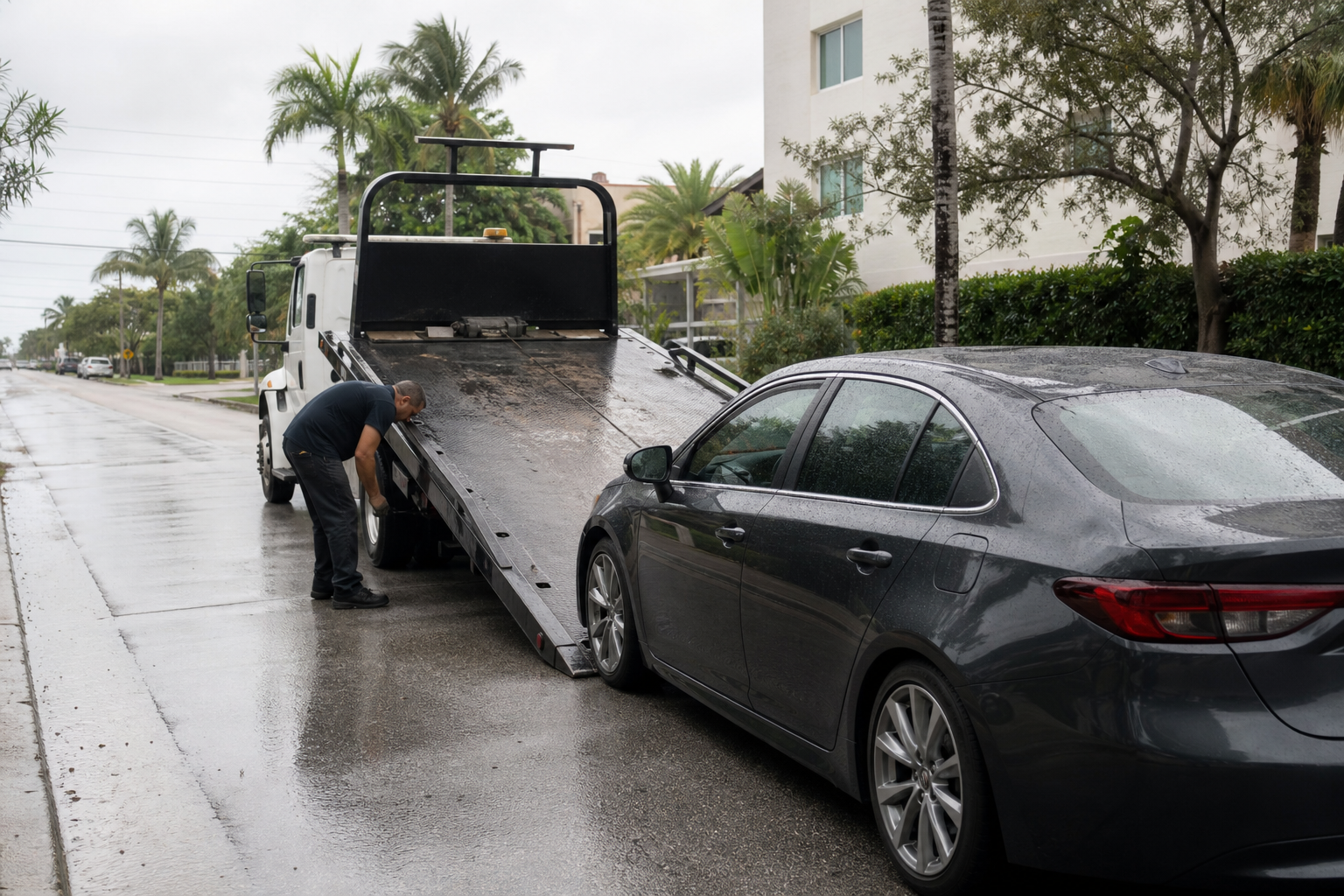
West Palm Beach decision point: Wet pavement can make a sloped shoulder, painted parking surface, or tight loading area harder to use safely. Do not stand beside the vehicle trying to identify its drivetrain while traffic passes. Your first decision is not flatbed versus wheel-lift—it is whether the location is safe enough for an ordinary towing pickup.
Quick answer: count the tires that may safely roll
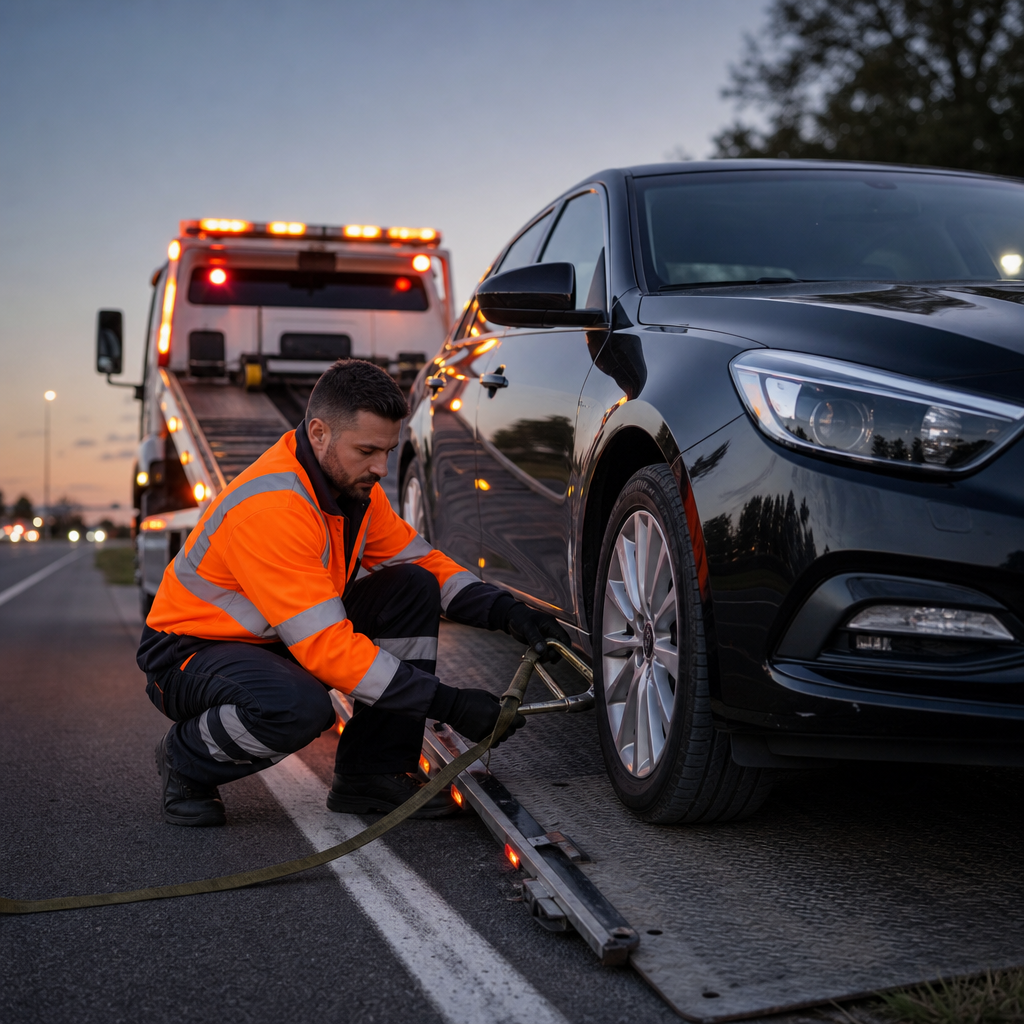
A flatbed carries all four tires off the road. That makes it the cautious choice when the vehicle’s towing instructions require one, the drivetrain cannot be confirmed, a wheel or suspension component is damaged, the car has very low clearance, or the vehicle cannot roll freely.
A wheel-lift raises one axle while the other axle rolls. It may be appropriate when the manufacturer permits that method, the tow operator can lift the driven wheels, the rolling wheels and tires are undamaged, and there is enough clearance for loading.
Do not assume every all-wheel-drive, four-wheel-drive, or low-clearance vehicle follows one universal rule. These are separate concerns:
- All-wheel drive: Some systems can be damaged if one axle rolls while the other is raised. Follow the owner’s manual or manufacturer towing instructions.
- Four-wheel drive: Transfer-case position and model-specific procedures matter. Do not rely only on a dashboard selector.
- Low clearance: The issue is loading angle and contact with bumpers, battery shields, or underbody panels—not drivetrain alone.
Do this, not that
| Situation | Do | Don’t |
|---|---|---|
| Vehicle is exposed to moving traffic | Move away from traffic if that can be done safely and call emergency services for an immediate hazard. | Inspect underneath the vehicle or stand between vehicles. |
| A tire, wheel, steering, or suspension part is damaged | Stop driving and describe the affected corner to the dispatcher. | Assume lifting the opposite axle makes the damage irrelevant. |
| Drivetrain or tow procedure is uncertain | Check the towing section of the owner’s manual or request a flatbed evaluation. | Guess based on the vehicle’s appearance or badge alone. |
| The vehicle only has a suspected dead battery | Consider jump start service if the location is safe and no other fault is evident. | Request a tow before checking whether a safe roadside start could resolve the problem. |
| Parking access is restricted | Report gates, ceiling height, sharp turns, soft ground, and the usable entrance. | Assume every tow truck can reach the vehicle. |
Make the tow-or-drive decision in five passes
1. Decide whether the car should move at all
Do not drive if steering or braking feels abnormal; a tire is flat, separated, or rubbing; fluid is pouring from the vehicle; temperature or oil-pressure warnings appear; the underbody is dragging; or a collision changed wheel alignment. Shut the vehicle down if continuing could worsen damage.
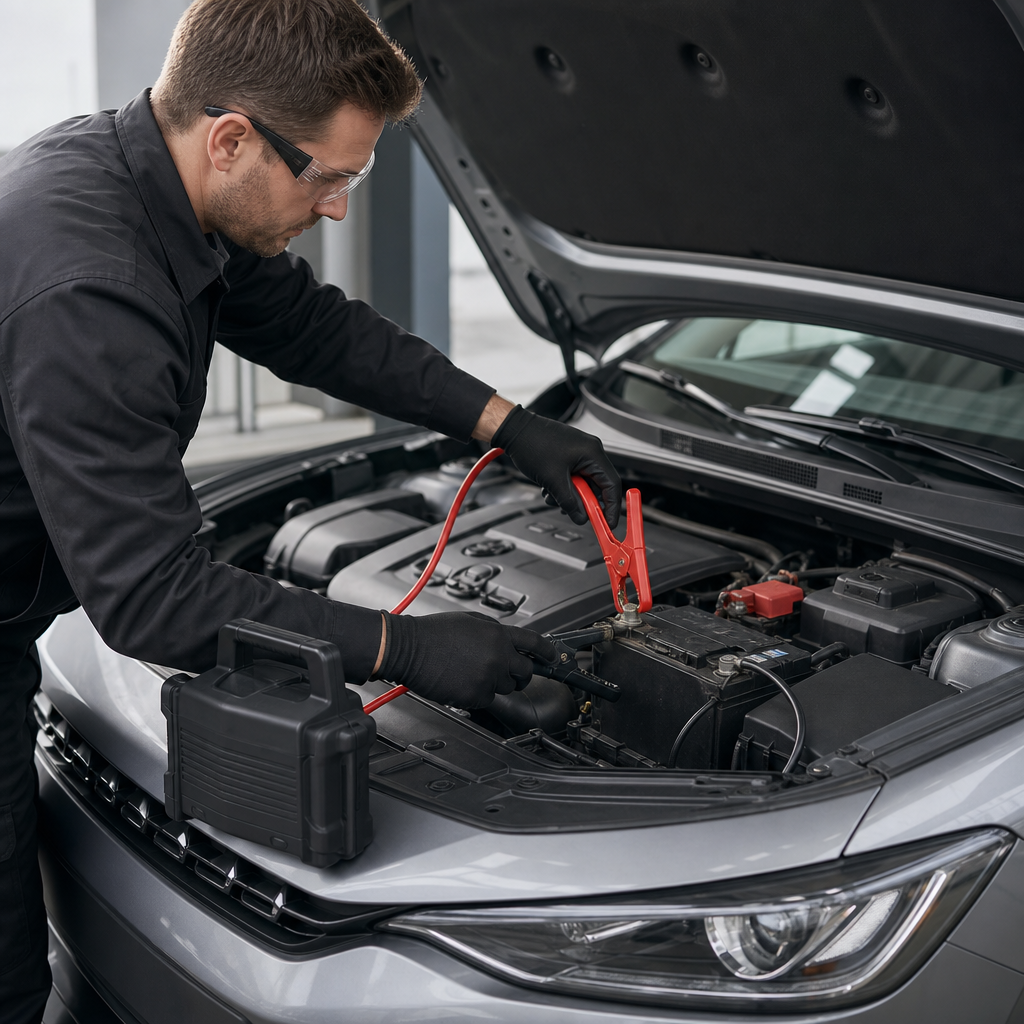
If the only symptom is a drained battery and the vehicle is otherwise intact, a roadside start may be the better first call. After a successful jump, do not continue merely because the engine runs: warning lights, stalling, unusual smells, or unstable electrical operation still justify towing.
2. Find the vehicle-specific towing instruction
Look in the owner’s manual index for “towing,” “recreational towing,” or “emergency towing.” The relevant instruction may specify flatbed transport, which axle must be raised, a maximum rolling procedure, or steps needed to release the transmission.
If the manual is unavailable, give the dispatcher the year, make, model, drivetrain if known, and whether the vehicle is electric, hybrid, front-wheel drive, rear-wheel drive, all-wheel drive, or four-wheel drive. Uncertainty is useful information; it tells the towing provider not to plan around an unsupported assumption.
3. Check each wheel’s ability to roll
From a safe position, note whether any tire is flat, a wheel sits at an unusual angle, or bodywork touches a tire. Do not crawl underneath. A wheel-lift still leaves one axle on the surface, so both tires on that rolling axle must be capable of turning safely.
If a non-lifted axle cannot roll, dollies may sometimes be used, but equipment compatibility and access must be confirmed. A flatbed tow is often the more straightforward plan when multiple wheels, steering, or suspension components are involved.
4. Test the loading location without moving the vehicle
The safest tow method must also fit the pickup area. In West Palm Beach, tell the dispatcher whether the car is on a street edge, in a garage, behind a gate, in a narrow parking aisle, or on a surface where a truck cannot align directly with it. Report overhead clearance and whether another vehicle blocks the front or rear.
A flatbed needs room to lower and extend its bed. A wheel-lift may fit a tighter approach, but tighter access does not override the manufacturer’s towing restrictions. The provider may need different equipment or a plan to reposition the vehicle before transport.
5. Give a location a driver can actually find
State West Palm Beach, Palm Beach County, Florida, then provide a map pin or exact address. Add the correct entrance, your position within the property, the direction the vehicle faces, and a clear description of the vehicle. If the pin falls at the front of a large property while the car is elsewhere, say so.
Finish with the condition that controls the tow: “front-left wheel will not roll,” “all-wheel drive, manual unavailable,” “low front clearance,” or “vehicle will not shift into neutral.” That single detail helps dispatch prepare more effectively than simply requesting “a tow truck.”
FAQs drivers ask before choosing a tow method
Can a wheel-lift tow an all-wheel-drive vehicle?
Only when the vehicle’s manufacturer permits the planned configuration and the operator has suitable equipment. Some vehicles may require dollies; others specify carrying all four wheels. The model-specific towing procedure is decisive.
Is a flatbed automatically damage-free?
No towing method removes every risk. Loading angle, underbody clearance, wheel condition, attachment points, and securement still matter. Tell the operator about loose panels, damaged suspension, or unusually low clearance before loading begins.
What if the transmission will not shift into neutral?
Do not force the shifter or drag the vehicle with locked wheels. Report the condition before dispatch so the provider can evaluate winching, wheel skates, dollies, or another loading approach.
Should I drive a short distance to create easier tow access?
Only if the vehicle is mechanically safe to move and doing so does not expose anyone to traffic. Do not drive on a damaged tire, compromised wheel, abnormal steering, fluid loss, or a serious warning indicator merely to make loading more convenient.
Calm handoff: If the vehicle should not be driven, contact 24-hour towing with the exact location, vehicle details, wheel condition, drivetrain information, and access limits. The towing provider can then confirm the appropriate equipment rather than asking you to make a risky roadside diagnosis.